Région Sud Art Prize : Maïssane Alibrahimi
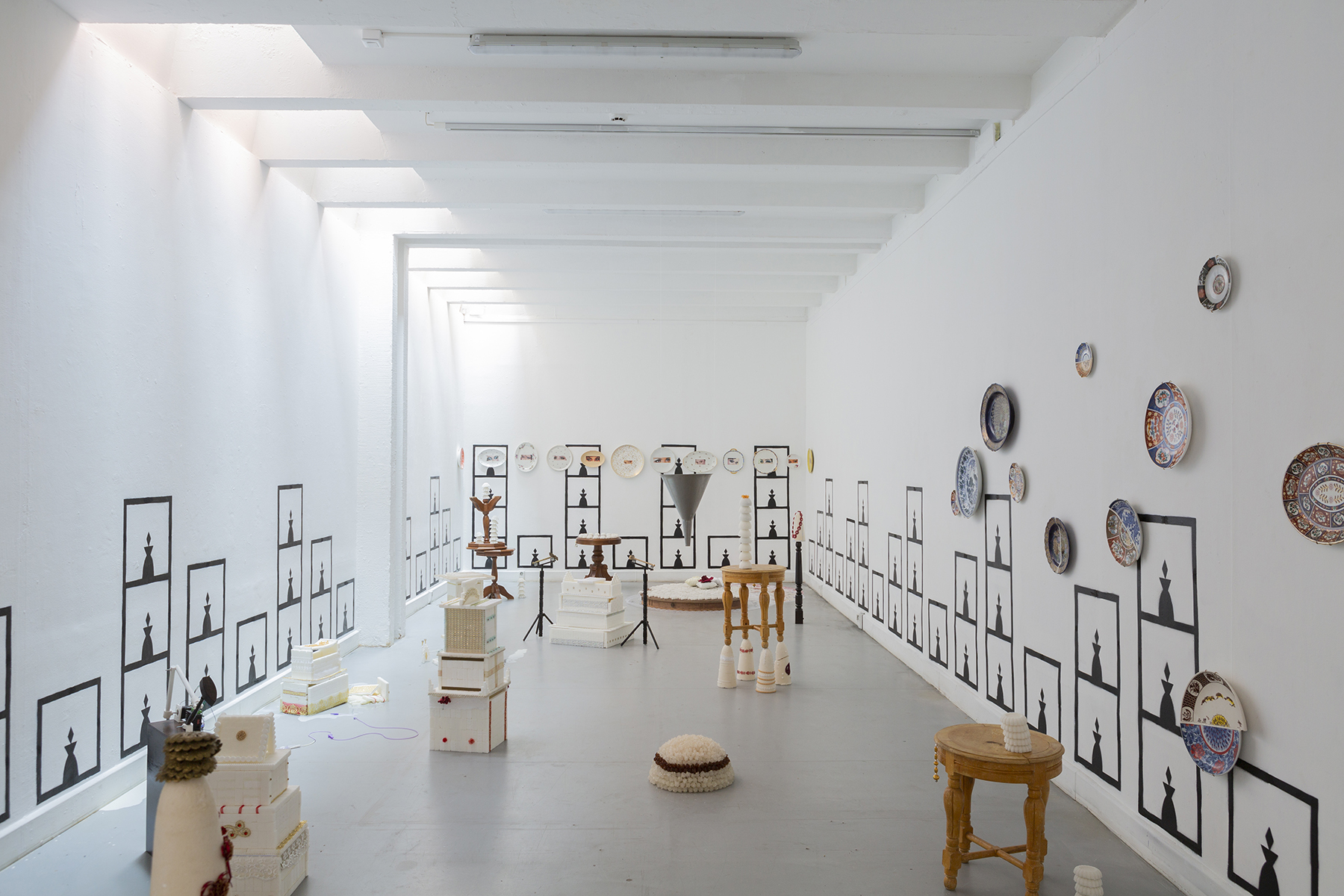
The first time I saw Maïssane Alibrahimi’s work, I had the feeling of arriving too late. As though the scene had already taken place, or was continuing elsewhere, out of my reach. As though a camera, somewhere, kept rolling — with that strange sensation of discovering a set still charged with action, even as everything appears motionless. A table is set, plates are arranged, a cushion bears wedding rings, fabrics fall to the floor. Nothing moves, and yet the space retains the trace of a recent movement. Bodies never appear, but persist everywhere, through imprints and through use.
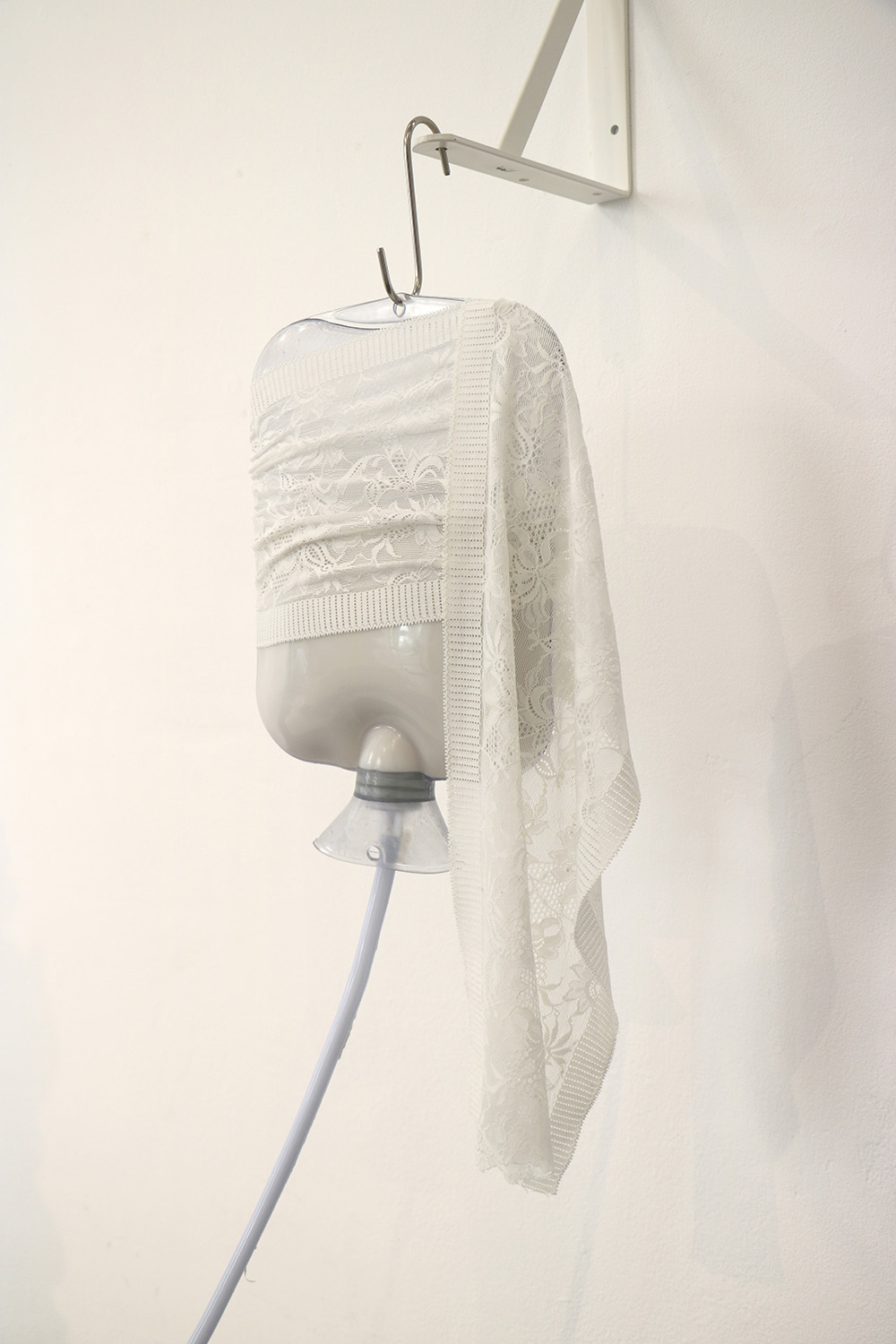
Her works begin well before their making, taking root in materials whose history precedes them. Sugar, porcelain, henna, beads, petals: none of these elements arrives untouched — each already carries a genealogy. Sugar, above all, runs through her practice as an ambivalent material. We tend to forget that Morocco was, as early as the ninth century, a major center of sugar production. For Maïssane, this substance becomes a compact material archive, standing at once for sweetness, extraction, and offering. It is what nourishes as much as what organizes, what binds as much as what controls — much like that wall-mounted IV drip which, falsely benevolent, tends to us even as it ties us down.
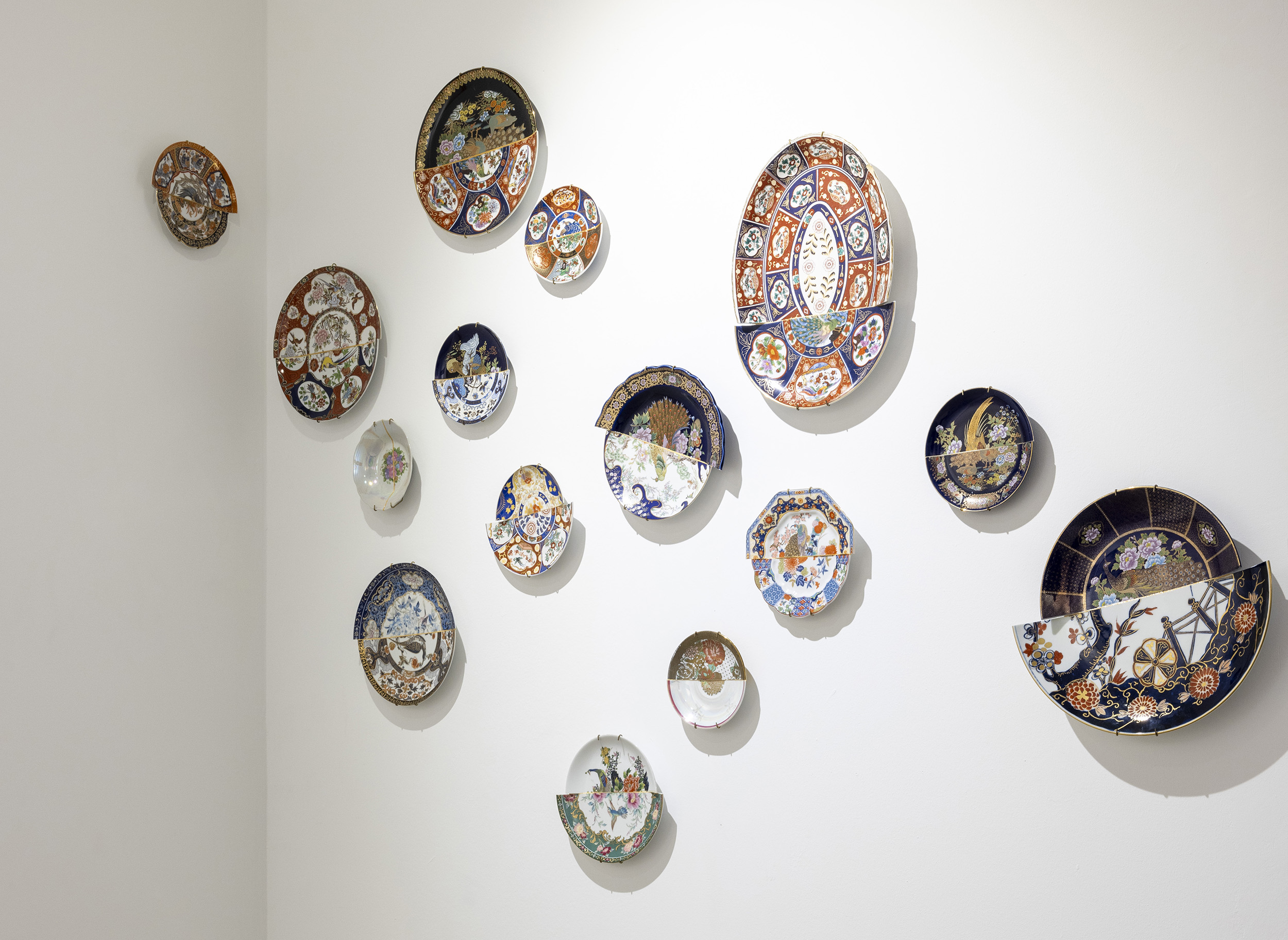
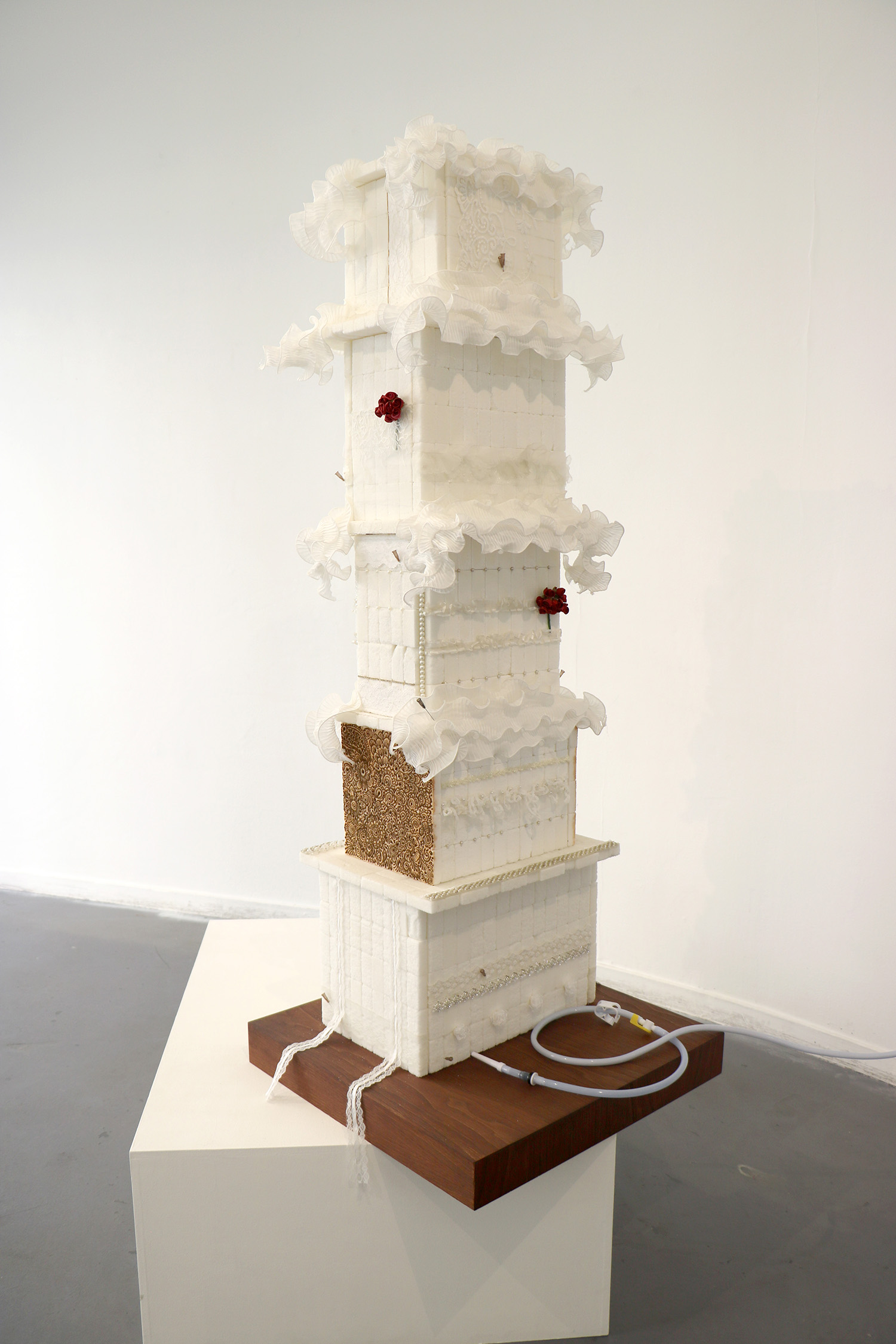
This ambiguity resurfaces across several of her sculptures. In Break the Sweet Sugar, sugar cubes rise into fragile, upright architectures, held together by an accumulation of ornaments hovering between adornment and wound. Her gesture is precise but does not aim for perfection: it lets forms coexist without fixing them, building while keeping the possibility of collapse alive — palimpsests where one layer covers another without erasing it. This logic is especially present in Sommaire de Taous Imari: the plates, broken and then repaired with gold powder, evoke Japanese kintsugi, yet the repair is anything but pacified. The crack remains central, telling as much of the violence of the gesture as of the possibility of synthesis. The artist brings together different ceramic traditions (Chinese and Moroccan among others) as one might juxtapose incompatible narratives, arriving at a result that is, paradoxically, harmonious and alive. La table de Mahr works the same way: a wedding scene, a ritual arrangement, almost a piece of domestic theater. But this theater is deserted. Haunted.
Against an era saturated with so-called immersive experiences, in which so many artists seem intent on producing an immediate, programmed relationship with the viewer, Maïssane takes the opposite path. Nothing here seeks to activate anything in the moment; everything appears suspended. And that is precisely where the movement begins: afterward. In the gaze, in the mental reconstruction of a sequence, in the effort to connect the signs. Turning the setting into a site of tension inhabited by its own abandonment — a full-fledged actor, no longer framing the action but becoming its last custodian, made up of objects and motifs that art history has long relegated to the realm of ornament. Where ornament is routinely associated with the feminine, the domestic, or the decorative, here it is repositioned at the center as a political language. Her works thus produce moments in which desire, transmission, control and memory coexist without ever resolving themselves. Much like certain films, her installations proceed by clues, leaving it to us to carry the story forward.
Pierre-Antoine Lalande
Bio
Maïssane Alibrahimi is a Franco-Moroccan artist whose practice interrogates power relations, patriarchal structures, and the narratives and constructions of femininity through a feminist and decolonial perspective.
She explores the tensions between softness and resistance, tradition and subversion, mobilising symbolic and domestic materials that she transforms into fragile, ornamented, and evolving structures, at the crossroads of sculpture, installation, and machinic performance. Drawing from the intimacy of the home, she extracts gestures, uses, and micro-rituals. Her work draws on the latencies of objects, ceremonial codes, and domestic images, exploring how the body inscribes its presence in time and space. By activating these ordinary forms, she uncovers fragments and totems of daily life whose banality conceals their symbolic weight.
Grounded in assembly, stacking, and the ephemeral, she develops an aesthetic of imbalance and transformation. Her gestures, at once meditative and transgressive, deconstruct normalised forms to reveal the latent violence inscribed in economic, social, familial, and spiritual structures.
Attentive to cultural transmissions and contradictory inheritances, she subverts the codes of ornamentation, traditional symbols, and rituals to reconfigure them as critical spaces, strategies of emancipation, displacement, and reappropriation.
A graduate of Villa Arson (Nice) and holder of an international MBA in Art from IESA (Paris), she lives and works between Paris and Rabat. In 2024, she was selected for the Arab Artists Now – Feminist Legacies programme led by K-oh-llective and Lina Ramadan. In 2025, she received the Audience Award at the Prix Icart Artistik Rezo and the Jury Prize at the Prix Dauphine pour l’Art Contemporain, alongside curator Juliette Hage.
https://www.instagram.com/hram3lik_/