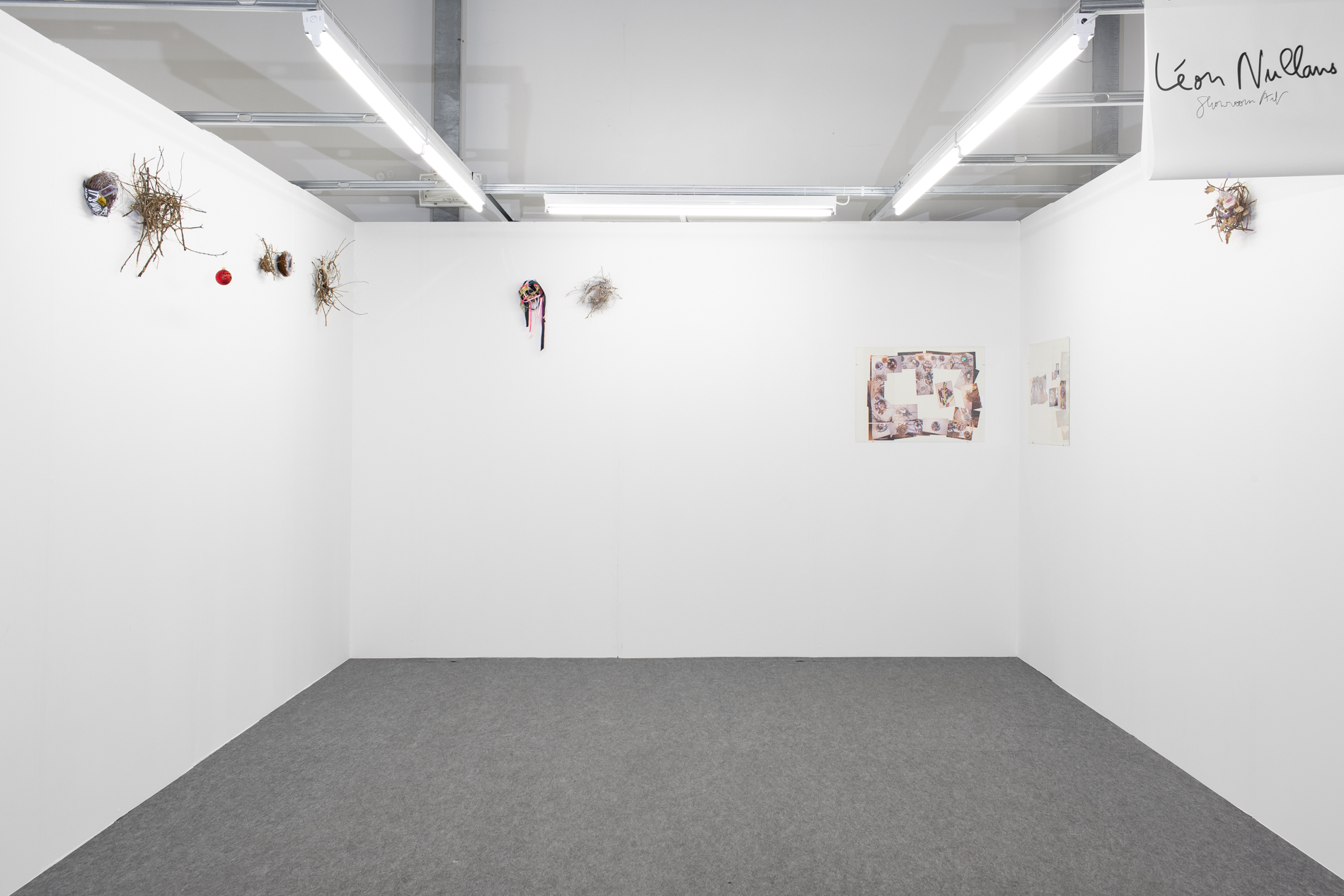
Showroom Art : Léon Nullans
Léon Nullans
“One must act in front of a work of art, too. The attention we give to it is an action in itself. If I don’t, in my own modest way, compose the Vespers of the Blessed Virgin while I’m listening to it, I do nothing, I hear nothing. And if I don’t write The Brothers Karamazov while I’m reading it, I do nothing.”
— Jean Genet
An almost imaginary conversation between Karen Kilimnik and Yasmine d’O. about Léon Nullans
YdO: Dear Karen, let me first say how grateful I am that you agreed to come all the way to Berlin to talk with me about your work—and that of Léon Nullans.
KK: The pleasure is mutual, Yasmine. I’m delighted to chat with you—especially in this strange city that’s kept a bit of that spooky vibe I’m so fond of.
YdO: I also need to thank Léon, who gave me the opportunity to dive into your remarkable work. I must admit, I wasn’t very familiar with it before. But Karen, do you know Léon?
KK: I don’t believe I’ve ever met him. Who is he?
YdO: A “young French artist, fresh out of school.” He knows you very well—or at least, your work and he is deeply immersed in it. Did you know he just presented a body of work for his graduation, entirely inspired by your practice?
KK: I’m flattered! But tell me more.
YdO: He said: “Kilimnik is now central to my work, not just as a proper name or simple reference, but as a direct marker that challenges the notion of aesthetics in my research. ”
KK: That’s a bit abstract… if I may say so.
YdO: Well, the show included a very scatter art-like installation on a grey pedestal, large watercolor murals you likely wouldn’t disown, a few photographs. And scattered throughout—nests. Everything pointed back to your work, and yet…
KK: There’s almost a childlike playfulness to it—like one of those games: “Let’s pretend I’m…Karen Kilimnik.”
YdO: (laughs) Yes! Like one of those mimicry games children use to build themselves up by stepping into other imaginations?
KK: Exactly—it’s as if Léon is slipping into a costume. And from what you’ve described, there’s something theatrical in it… Has my work become a set?
YdO: You’re right—he might be embracing a role for which you and your work are the costume. Which isn’t so far, after all, from those female figures you’ve painted so often—those alter egos with multiple personalities, placed in various times and settings, through which you expressed something of yourself. Borrowed inheritances you used to define yourself.
KK: Perhaps I’ve become an alter ego myself? (laughs) Yes… That’s what you call in French “l’ironie du sort.” You’ll say I brought this on myself, won’t you? Maybe it’s just the beginning—maybe I’m only the first link in a long chain of artist-alter-egos yet to come for Léon.
YdO: Beyond the understandable desire to place oneself within a given history or artistic community, don’t you think that revealing oneself through another is a kind of modesty? A veil that shields the artist’s deeper feelings—and raises that eternal question of sincerity? It reminds me ofthat beautiful scene in Tarkovsky’s Stalker, when the characters finally reach the wish room—the ultimate goal of their quest—and realize the room will fulfill only their most deeply hidden desires. No one dares to enter, afraid of what they might discover about themselves…
KK: …Yes, for any artist, a work is like that room—all wishes are allowed—but it also exposes what is hidden inside us, our obsessions. And yet, one must take the risk of creating meaningful work… one must expose oneself to the risk of making a true artistic (or intellectual) statement. (laughs) Maybe this kind of strategy is also a way of dodging our old friend, the ego—that necessary engine of action, but sometimes such a burden, even a hindrance? So what has Léon planned for the upcoming presentation at the Art-o-rama Showroom?
YdO: Well, you’ll be surprised—he’s doing it again. This time, he wants to focus on creating a series of nests. Nests in your style, of course, which he plans to make with his aunt.
KK: If I may… the bird is feathering his…
YdO: …Nest, yes. It is rather strange that he chose nests for this exhibition—and even more so that he asked his aunt—who’s into crafts—to co-create them with him. I’m not entirely sure how to interpret that. It’s almost regressive: “back to the nest, with auntie.” But then, you yourself have kept something adolescent in your work…
KK: You know, anything has the potential to become something else. And surely my nests—or rather, these nests remade by Léon and his aunt, invoking me like some sort of pagan deity—take on a whole new meaning in the violent climate of the 2020s. In any case, I’m curious to see.
YdO: Léon proposed a title for this presentation: a simple “Nests by Karen Kilimnik”, an exhibition by Léon Nullans. What do you think?
KK: (laughs) Yes, that sounds perfect. Says it all.
In the early 1990s, Karen Kilimnik began creating installations belonging to the genre of American scatter art: found objects, assembled and scattered across the floor in a way that appears random, with no particular formal intent.
This conversation took place in Saâdane Afif’s studio in Berlin, August 2025