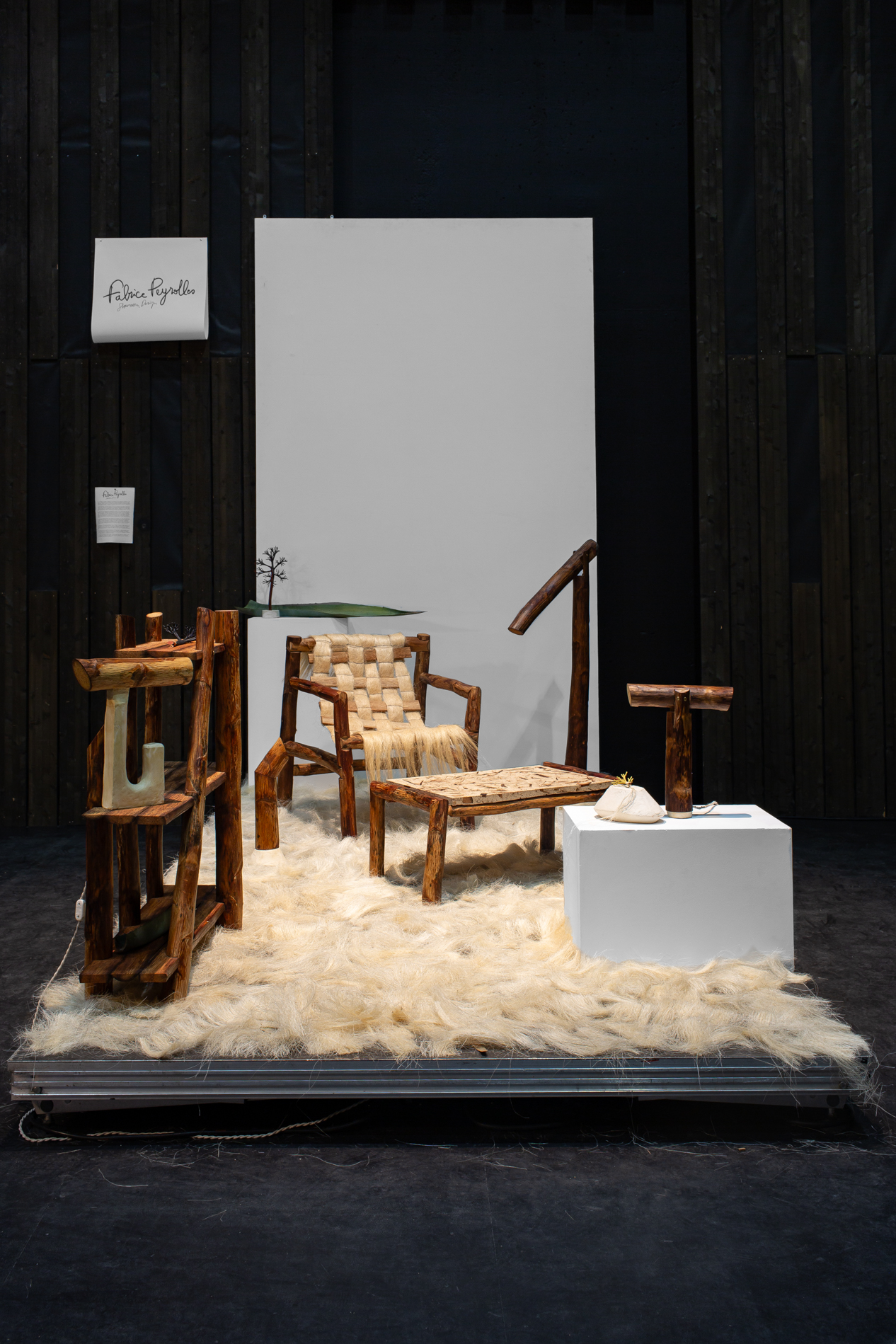
Design Sowroom: Fabrice Peyrolles
Fabrice Peyrolles
With a background in engineering, Fabrice Peyrolles explored the world of Ebénisterie at the Ecole Boulle in Paris, before earning a Master’s degree in Creation and Contemporary Technology at the ENSCI. Now based in Marseille, he is a designer-researcher, weaving a dialogue between design, life and traditional knowledge. This research is materialized by the realization and documentation of projects whose accumulation outlines the contours of an ethical way of Producing, in harmony with the natural world.
At the intersection of object design, craftsmanship, and critical ecology, Fabrice Peyrolles’ work questions our relationship with materials and the life forms that produce them. Through a serie of objects made entirely from Agave americana, a robust plant with sculptural features, harvested from the rugged Mediterranean coastline, he engages in a subtle dialogue between the designer’s gesture and the contradictory dynamics of living things.
Agave americana, introduced to southern France in the 14th century, has taken root vigorously in the cracks of limestone, even colonizing certain parts of the Calanques National Park. Manual removal campaigns are regularly carried out to restore natural environments. Some see it as nothing more than ecological disorder, but Fabrice Peyrolles perceives it as material to be revealed, a plant memory to be listened to, and a care for living things that inspires him.
By collecting these fragments of landscapes in tension and transforming them using demanding artisanal techniques, he does more than simply recycle: he reconstructs a narrative. His objects, which follow the standards of object design—armchairs, lamps—are fragments of a fractured world. They bear the traces of uprooting, proliferation, and the slow transformation of the ecosystem. Their manufacture is designed to minimize environmental impact, imagining production methods that do not harm living organisms, but rather support the preservation of the Calanques Regional Park.
He studies ancient techniques, tracing them back to their origins in the plant—not to reproduce them identically, but to understand their material logic, their biorhythms, and their ways of being in the world through action. From fiber extraction to wood processing, he engages in a design practice where the hand does not dominate the material, but works with it. This localized intelligence unfolds in an economy of means, where each element responds to the whole, and where form arises from a process of material and formal understanding. The Maguey armchair encapsulates this approach.
This poetic rehabilitation work itself needs to be re-evaluated. Recently, a discreet insect—the black agave weevil—has been causing the decline of these plant populations. Introduced in turn, it silently eats away at the plant from the inside, accelerating its disappearance. What was once considered invasive has suddenly become ephemeral. The raw material for the project is becoming scarce, and with it, the very possibility of the gesture.
Fabrice Peyrolles’ work is therefore set in a suspended moment in time, that of impending disappearance. By transforming a contested resource into an artifact, he reveals the unstable condition of all matter in a finite world. His pieces carry the memory of a plant that is both hated and on borrowed time, and reflect the ethics of a design that is attentive to damaged ecosystems.
Contrary to productivist logic, Fabrice Peyrolles crafts designs from little, from almost nothing. Here, the object becomes an active vestige, an imprint of a territory where the tensions of our time are replayed: between nature and culture, craftsmanship and biopolitics, survival and erasure.
Text by Camille Lamy