Design Showroom: Atelier Zerma
Atelier Zerma – Infiltrated Designer: A Covert Practice
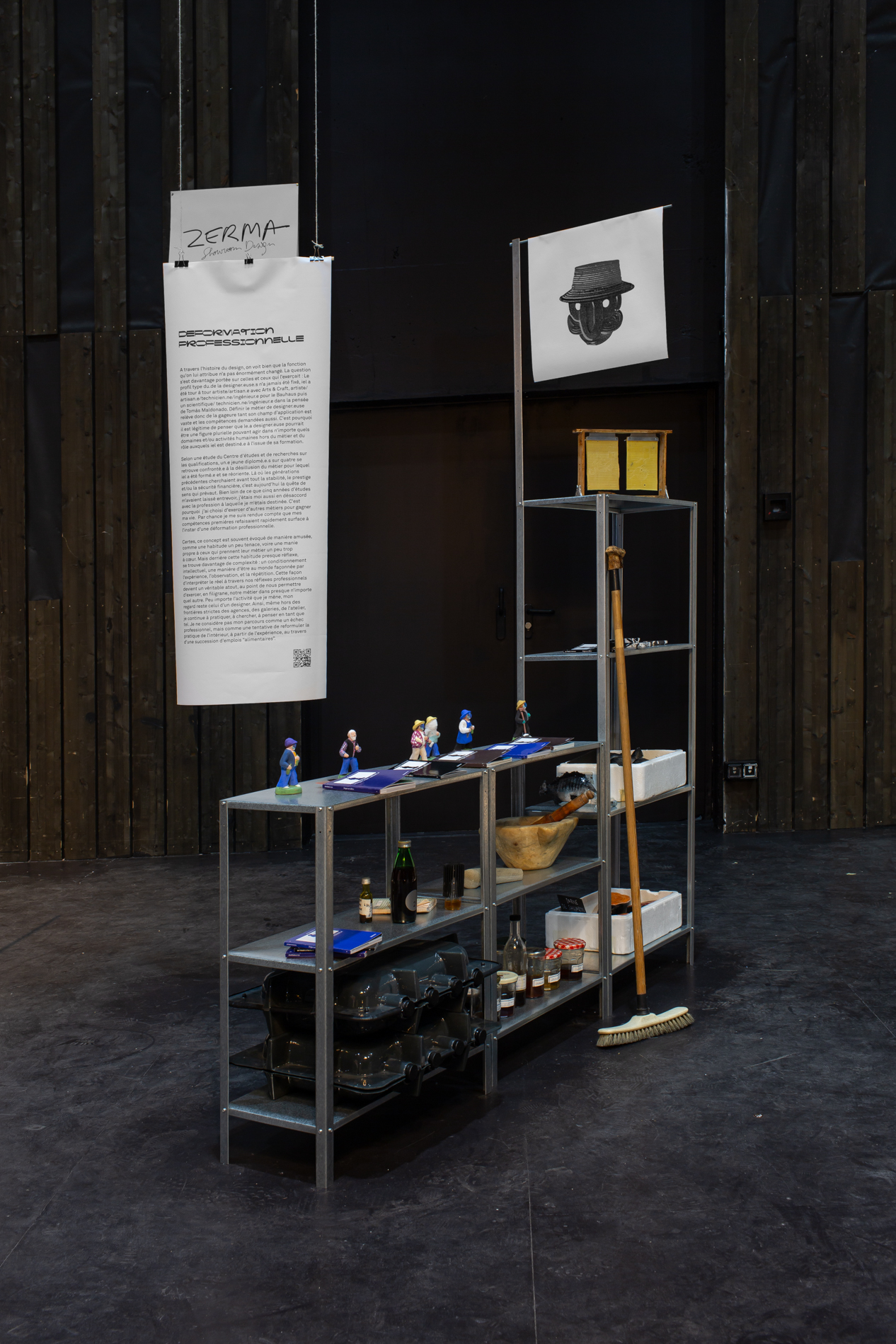
At Atelier Zerma, design does not impose itself, it infiltrates. It slips into the gaps, divets existing devices, adopts vernacular forms to better reveal untold stories and parallel economies. By setting up shops in unexpected places – in the closet of a school, a fish market, a santon nativity scene, a marble sculptor’s workshop, a scooter delivery drivers bag or a museum’s maintenance room — Atelier Zerma’s work adopts a critical, skillfully dissident stance. This is what the work zerma tells us, from the Maghrebi Arabic “Zarma, za’ma,” a slang interjection meaning “so-called,” “sort of,” expressing irony, cynicism, doubt, or misappropriation. Atelier Zerma produces design without our knowledge, in the womb of a capitalist society where class and labor violence are not always openly acknowledged.
This approach to design is neither solutionist nor universalist, nor does it seek to embrace the ambition of innovation or fulfill the social role and utility attributed to it by society. The infiltrated designer decentralizes the role of the author by becoming a researcher, an agent complicit in collective storytelling, directly engaged with the economic, social, and material issues of their time.
This stance was born out of necessity. Out of the impossibility of separating design research from economic survival. Each project presented here is also a response to the precarious status of artists, authors, and designers: earning a degree while creating a clandestine micro-enterprise to finance it; transforming an unpaid exhibition into a paid performance; producing narrative objects sold in the form of figurines to disseminate one’s work at a lower cost, subcontracting one’s work under someone else’s name, illegally camouflaging an urban beehive to develop a nomadic business, opening up discussion between museographers/exhibition curators and maintenance workers within a museum with a view to preserving bodies and spaces.
So many strategies to devise, so many workers to embody, so many professions to infiltrate; ultimately, the Zerma workshop practices and champions the concept of “deformation design,” or a design that one decides to abandon in favor of another profession, only to find it resurfacing almost in spite of oneself. Each production, each profession infiltrated, each stance adopted is meticulously documented in a publication that provides us with the keys to understanding this clandestine practice.
Faced with demands for free services, visibility as currency, precarious contracts, or no contracts at all, Atelier Zerma is inventing other models: DIY, hybrid, pirate. The designer becomes a distiller, a fishmonger, a smuggler, a laborer, a beekeeper, or a shepherd of dust sheep, depending on the circumstances. Through this poetic and political infiltration, the practice of design asserts itself as a form of resistance, a research in action, rooted in reality and focused on those who live it.
It is an impulse that comes from within, a subaltern revolution.
Text by Camille Lamy